Revenue Architecture Diagnostic Intensive (6–8 weeks)
A structured evaluation of how your revenue system operates
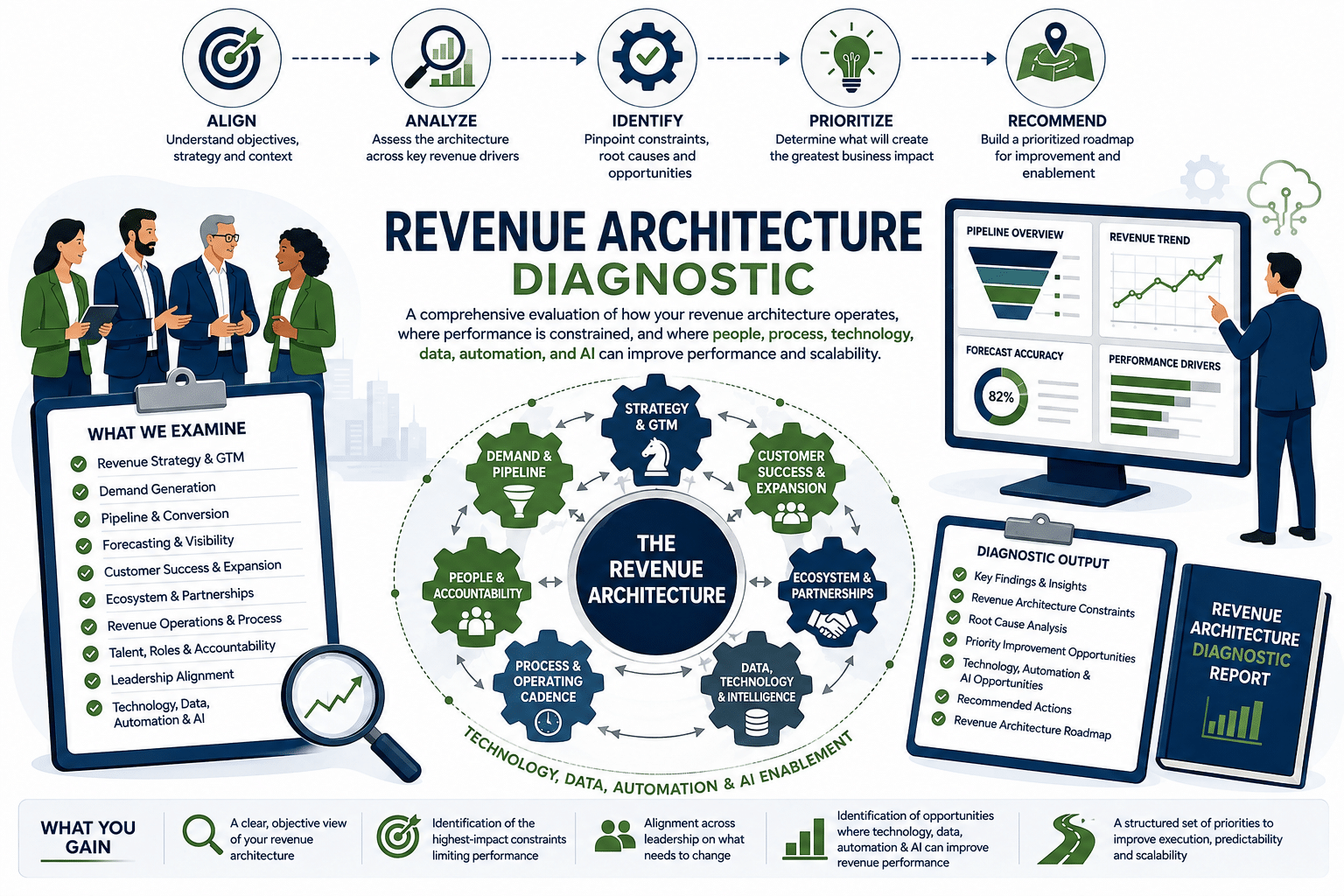
This diagnostic is a focused, time-bound engagement designed to evaluate how your revenue system performs across demand generation, pipeline development, go-to-market execution, forecasting, customer retention and expansion, partnerships, leadership alignment, talent structure, revenue operations, technology, data, and AI enablement.
The objective is to identify where performance is constrained, determine where process, technology, data, automation, and AI can improve revenue performance, and provide clear, actionable direction to improve consistency and scalability. Most engagements begin with a structured revenue diagnostic to establish that clarity and direction.
Start with a Revenue Diagnostic Consultation
Complete the intake form below to get started.
We’ll use this information to make the conversation focused and relevant.
Engagement Structure and Deliverables
Week 1: Alignment and Diagnostic Planning
Focus: Establish context, scope, and priorities
Activities:
- Kickoff session with leadership team
- Clarify business objectives and growth targets
- Define scope across sales, marketing, customer success, operations, technology, data, and AI enablement
- Identify key stakeholders and data sources
Deliverables:
- Diagnostic scope and engagement plan
- Stakeholder interview schedule
- Initial view of potential constraint areas
Week 2: Leadership Alignment and Decision Flow Review
Focus: Understand how decisions are made and executed
Activities:
- Conduct leadership interviews
- Evaluate alignment on priorities, metrics, and growth strategy
- Review how decisions translate into execution across functions
Deliverables:
- Leadership alignment and decision flow summary
- Identification of gaps in cross-functional coordination
- Early insights on execution risks
Week 3: Demand and Pipeline Performance Review
Focus: Evaluate how demand converts into pipeline and revenue
Activities:
- Review demand generation sources and quality
- Analyze pipeline structure, coverage, and conversion
- Identify bottlenecks in funnel progression
- Evaluate opportunities for technology, automation, data, and AI to improve pipeline visibility, prioritization, and conversion
Deliverables:
- Pipeline performance and coverage analysis
- Conversion insights across stages
- Identification of pipeline constraints
- Identification of relevant enablement opportunities
Week 4: Go-to-Market Execution Review
Focus: Assess how strategy translates into field execution
Activities:
- Review positioning, messaging, and GTM model
- Evaluate alignment between marketing, sales, and customer success
- Identify inconsistencies in execution across teams or regions
- Assess opportunities to improve GTM execution through technology, automation, data, and AI where appropriate
Deliverables:
- Go-to-market alignment and execution summary
- Identification of gaps between strategy and execution
- Recommendations to improve consistency
Week 5: Forecasting and Operating Cadence Review
Focus: Evaluate visibility, predictability, and performance management
Activities:
- Review forecasting process and methodology
- Assess pipeline hygiene and reporting discipline
- Evaluate operating cadence, including pipeline reviews, forecast calls, and performance tracking
- Assess opportunities to improve forecasting, pipeline intelligence, reporting, and decision support through technology, automation, data, and AI
Deliverables:
- Forecasting maturity and reliability assessment
- Pipeline visibility and reporting insights
- Recommendations to improve forecasting discipline
- Identification of relevant intelligence and automation opportunities
Week 6: Talent Structure and Accountability Review
Focus: Assess how roles and responsibilities support performance
Activities:
- Review role definitions and accountability across the revenue organization
- Evaluate alignment between talent and growth objectives
- Identify gaps in coverage, capabilities, and ownership
- Assess where technology, automation, and AI may augment team capabilities, improve productivity, or reduce unnecessary manual work
Deliverables:
- Role clarity and accountability summary
- Identification of talent and capability gaps
- Recommendations for improving alignment
Week 7: Synthesis and Constraint Identification
Focus: Consolidate findings into a system-level view
Activities:
- Synthesize insights across all areas
- Identify root causes of performance constraints
- Prioritize issues based on impact and urgency
- Identify opportunities where process, technology, data, automation, and AI can address constraints or improve revenue performance
Deliverables:
- Diagnostic summary of key findings
- Prioritized list of constraints
- Clear articulation of root causes
- Identification of high-value enablement opportunities, including AI where appropriate
Week 8: Executive Readout and Next Steps
Focus: Provide clarity, alignment, and direction
Activities:
- Present findings to leadership team
- Review prioritized actions and implications
- Identify where organizational, process, technology, data, automation, or AI-enabled interventions are appropriate
- Align on next steps and engagement options
Deliverables:
- Executive presentation
- Revenue Architecture diagnostic report
- Recommended roadmap for improvement
- Prioritized recommendations for enablement and transformation initiatives
Important Note on Leadership Evaluation
This diagnostic includes a review of leadership alignment, decision-making, and execution as it relates to revenue performance.
It does not include formal psychometric or leadership assessment tools. Where deeper individual or team-level evaluation is required, separate leadership diagnostic engagements are recommended.
What You Gain
- A clear, objective view of how your revenue system operates
- Identification of the highest-impact constraints limiting performance
- Alignment across leadership on what needs to change
- Identification of opportunities where process, technology, data, automation, and AI can improve revenue performance
- A structured set of priorities to improve execution, predictability, and scalability

This diagnostic provides a structured starting point for organizations seeking to improve how their revenue system performs and scales. While the diagnostic follows a structured methodology, elements of the engagement may be adapted to reflect the client’s specific objectives, operating environment, and areas of priority. Technology, automation, data, and AI opportunities are evaluated based on their potential to address identified revenue constraints and create measurable business value.