Revenue Performance Architecture
Structuring Revenue for Consistent Performance
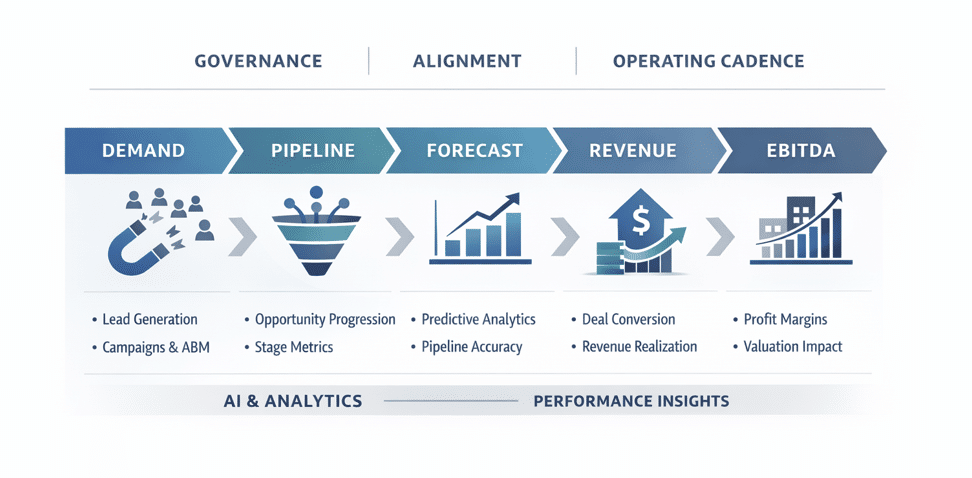
Revenue Performance Architecture defines how demand, pipeline, forecasting, and execution operate as a unified system.
Most growth challenges are not caused by lack of effort. They result from disconnected processes, inconsistent execution, and limited visibility across the revenue lifecycle.
This work is delivered through an ongoing advisory engagement that aligns how revenue is structured, governed, and executed, enabling leadership to operate with clarity, control, and consistency.
Where Revenue Performance Breaks Down
Revenue performance becomes inconsistent when:
- Demand generation and sales operate against different assumptions.
- Pipeline stages exist, but progression and conversion logic are unclear.
- Forecasts are produced but not trusted.
- Revenue targets are set without alignment to execution capacity.
- Execution varies across teams, regions, or segments.
These are not isolated issues. They are indicators of a system that is not functioning cohesively.
What This Changes
Revenue Performance Architecture focuses on how revenue is structured and governed, not on increasing activity.
The work centers on:
- Defining how demand translates into pipeline in alignment with the buyer journey.
- Establishing clear pipeline progression and stage-level conversion logic
- Structuring forecasting as a forward-looking decision system, not a reporting exercise
- Aligning operating cadence to reinforce accountability and performance visibility
- Clarifying roles, ownership, and coverage across the revenue organization
- Integrating partner, channel, and ecosystem motions into the revenue system
The result is not more activity, but more consistent execution.
Data and Process Clarity
Data and analytics are only valuable when they improve decisions.
This work focuses on:
- Identifying where pipeline progression and conversion break down.
- Evaluating demand effectiveness relative to revenue outcomes
- Ensuring CRM structure supports forecasting and visibility.
- Simplifying processes that introduce friction or inconsistency.
AI and analytics are applied selectively to strengthen visibility and decision quality, not to add operational complexity.
Outcomes
Organizations applying this discipline typically see:
- More consistent pipeline progression
- Increased confidence in forecasts
- Reduced variability in performance
- Clearer executive visibility
- Stronger alignment across functions
Who This Is For
This work is designed for CEOs, CROs, and executive teams that need:
- Greater control over revenue performance
- Clarity in how growth is generated.
- Alignment across functions without added complexity.
- A system that can scale with the business
Next Step
This work begins with a structured conversation to assess how your revenue system currently operates and where it breaks down.
