Leadership Team Effectiveness Diagnostic
Executive leadership team diagnostic and advisory to improve organizational alignment, execution effectiveness, and revenue performance
High-performing organizations rarely outperform the effectiveness of their leadership teams.
As organizations grow, leadership teams become responsible for aligning strategy, allocating resources, making decisions, resolving conflicts, managing priorities, and ensuring execution across functions. The quality of these interactions directly influences organizational performance, execution effectiveness, and growth outcomes.
When leadership teams lack alignment, trust, accountability, or a shared understanding of how they operate together, execution slows, friction increases, and organizational performance suffers.
AlliancesHub applies evidence-based leadership team diagnostics to help CEOs, CROs, founders, partners, and executive leadership teams identify strengths, alignment opportunities, and behavioral patterns that influence organizational performance. These insights provide a foundation for strengthening leadership team effectiveness, improving execution, and supporting sustainable growth and revenue outcomes.
Leadership Team Effectiveness Advisory is frequently utilized alongside Revenue Architecture Advisory when organizations seek to improve both executive alignment and revenue performance.
Why Leadership Team Effectiveness Matters
Leadership teams function as organizational execution systems.
The effectiveness of a leadership team directly influences:
- Strategic alignment
- Decision quality
- Resource allocation
- Cross-functional collaboration
- Accountability
- Organizational execution
Even highly capable individual leaders may struggle to achieve results when the leadership team itself lacks cohesion, trust, or alignment.
When leadership teams are ineffective, organizations often experience:
- Slower decision-making
- Conflicting priorities
- Cross-functional friction
- Reduced accountability
- Communication breakdowns
- Inconsistent execution
Over time, these challenges limit organizational performance, reduce scalability, and weaken growth initiatives.
Leadership team effectiveness is often the hidden constraint limiting organizational performance.
Leadership Team Effectiveness Becomes More Important As Organizations Grow
As organizations grow, leadership team dynamics become increasingly complex.
What worked with five leaders often becomes ineffective with ten. What worked during early-stage growth may no longer support organizational scale, transformation, geographic expansion, acquisitions, or increasing operational complexity.
As organizations grow, leadership teams must:
- Align larger organizations around common priorities
- Make faster and more complex decisions
- Coordinate across multiple functions
- Manage competing priorities
- Influence execution through others
- Maintain trust and accountability under pressure
Without intentional leadership team development, organizations often experience:
- Functional silos
- Leadership bottlenecks
- Slower execution
- Decision paralysis
- Reduced accountability
- Organizational friction
The Leadership Team Effectiveness Diagnostic helps executive teams identify and address these constraints before they impact organizational performance, execution effectiveness, and revenue growth.
Common Leadership Team Challenges
Leadership teams often engage this service when they:
- Need greater executive alignment
- Experience recurring cross-functional conflict
- Want to improve decision-making effectiveness
- Need stronger accountability across the leadership team
- Are preparing for growth, transformation, or organizational change
- Want to improve collaboration across functions
- Need an objective assessment of leadership team dynamics
- Seek to improve execution effectiveness across the organization
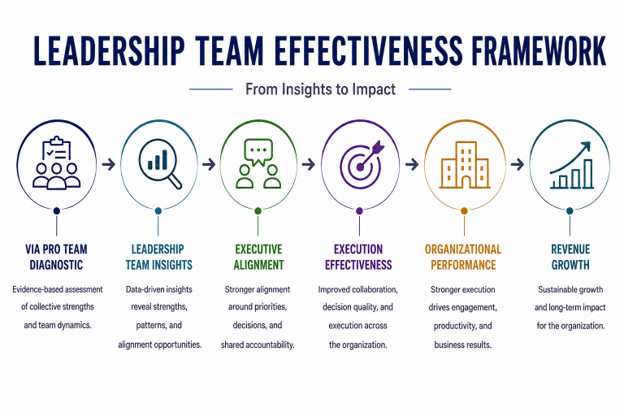
Leadership Team Effectiveness Framework
Leadership team effectiveness depends on more than organizational structure, experience, or technical expertise. High-performing leadership teams demonstrate alignment across critical dimensions that influence how they collaborate, make decisions, and execute together.
Character Strengths & Leadership Team Culture
What strengths shape the leadership team’s culture?
The VIA Pro Team Diagnostic evaluates the collective character strengths profile of the leadership team and identifies how strengths influence communication, trust, collaboration, accountability, and execution.
Understanding the team’s collective strengths culture provides insight into how leaders naturally approach challenges, engage with one another, and contribute to organizational performance.
Leadership Team Alignment
How effectively does the leadership team align around priorities and decisions?
The diagnostic evaluates how leadership strengths influence:
- Strategic alignment
- Priority setting
- Decision-making
- Resource allocation
- Accountability
- Leadership cohesion
This analysis helps leadership teams identify where alignment supports performance and where misalignment may create execution challenges.
Leadership Team Execution
How effectively does the leadership team execute together?
The analysis provides visibility into how leadership team behaviors influence:
- Cross-functional collaboration
- Organizational communication
- Stakeholder alignment
- Trust and accountability
- Execution discipline
- Organizational performance
These insights help leadership teams understand how behavioral patterns translate into execution outcomes across the organization.
Data-Driven Leadership Team Diagnostics
AlliancesHub uses the VIA Pro Team Diagnostic from the VIA Institute on Character to generate a data-driven profile of the executive team’s collective strengths culture.
The diagnostic may provide insight into:
- Leadership team strengths culture
- Underrepresented strengths
- Overused or misapplied strengths
- Executive alignment
- Decision-making effectiveness
- Trust and collaboration
- Sources of friction and conflict
- Accountability dynamics
- Execution effectiveness
- Opportunities for organizational improvement
These insights create a fact-based foundation for leadership team advisory and organizational development.
Leadership Team Effectiveness Advisory
Following the diagnostic, organizations may engage in Leadership Team Effectiveness Advisory to translate assessment insights into practical actions that strengthen executive alignment, collaboration, decision-making, accountability, and execution.
The advisory engagement focuses on helping leadership teams improve how they operate as a system and how they collectively influence organizational performance.
Organizations frequently combine Leadership Team Effectiveness Advisory with Revenue Architecture Advisory when executive alignment and execution effectiveness are limiting revenue performance, organizational scalability, or growth initiatives.
Areas of focus may include:
- Executive alignment
- Strategic prioritization
- Leadership team communication
- Decision-making effectiveness
- Accountability structures
- Trust and collaboration
- Cross-functional execution
- Organizational effectiveness
Engagements are time-bound, outcome-oriented, and aligned to organizational priorities, strategic initiatives, and growth objectives.
Typical Engagement Structure
Leadership Team Effectiveness Diagnostic
- VIA Pro Team Diagnostic
- Leadership Team Analysis
- Executive Team Debrief
- Leadership Team Effectiveness Roadmap
Followed by:
- Leadership Team Effectiveness Advisory
- Executive Alignment Meetings
- Accountability and Progress Reviews
- Strategic Working Meetings
- Application to Live Business Challenges
Leadership Team Effectiveness Workshop
Organizations may choose to apply diagnostic insights through a facilitated Leadership Team Effectiveness Workshop.
Prior to the workshop, participating leaders complete the VIA Assessment, allowing the organization to generate a VIA Pro Team Diagnostic profile and leadership team strengths analysis.
This facilitated workshop helps leadership teams understand their collective strengths culture, identify areas of alignment and friction, and explore how leadership behaviors influence organizational performance.
The workshop may focus on:
- Leadership team strengths culture
- Executive alignment
- Trust and collaboration
- Decision-making effectiveness
- Accountability
- Cross-functional execution
- Organizational communication
Participants gain practical strategies to leverage collective strengths, address potential team constraints, and improve how the leadership team operates as an execution system.
Organizations seeking sustained organizational impact may continue into Leadership Team Effectiveness Advisory following the workshop.
Research & Evidence
Leadership team effectiveness is a measurable driver of organizational performance.
Research consistently demonstrates that leadership alignment, trust, communication, accountability, and decision-making effectiveness influence employee engagement, organizational execution, business performance, and growth outcomes.
Explore leadership effectiveness research, assessment validation studies, and case studies demonstrating how organizations have used evidence-based diagnostics to strengthen leadership teams and improve organizational performance.

Business Outcomes
Organizations use this service to:
- Improve executive alignment
- Increase decision quality and accountability
- Strengthen cross-functional collaboration
- Improve communication and trust
- Accelerate execution effectiveness
- Reduce organizational friction
- Strengthen organizational performance
- Support sustainable growth and revenue outcomes
Turn leadership team effectiveness into a competitive advantage.
