Executive Leadership Effectiveness Diagnostic
Executive leadership diagnostic and advisory to improve organizational performance, revenue growth, and execution effectiveness
High-performing organizations succeed not only because of strategy, but because of the leadership behaviors that determine how effectively strategy is executed at scale. Leadership effectiveness directly influences executive decision quality, alignment under pressure, communication effectiveness, collaboration, accountability, and execution discipline across complex environments.
Leaders who consistently demonstrate self-awareness, resilience, adaptability, sound judgment, and influence create the conditions necessary for sustainable growth and organizational success. Conversely, when leadership effectiveness is constrained, organizations often experience slower decision-making, misalignment, execution friction, and reduced organizational performance.
AlliancesHub applies evidence-based leadership diagnostics to help founders, CEOs, CROs, partners, business unit leaders, and senior executives identify leadership strengths, development opportunities, and behavioral patterns that influence organizational performance. These insights provide a foundation for improving leadership effectiveness, strengthening execution, and supporting sustainable growth and revenue outcomes.
Why Leadership Effectiveness Matters
Leadership effectiveness influences how organizations make decisions, align around priorities, execute strategy, and respond to change.
Even the strongest strategy, technology investments, and operating models depend on leadership behaviors that drive accountability, collaboration, communication, and execution.
When leadership effectiveness is constrained, organizations often experience:
- Slower decision-making and execution
- Misalignment across functions and teams
- Reduced accountability and ownership
- Communication breakdowns and organizational friction
- Difficulty navigating growth, change, and complexity
- Lower engagement and leadership effectiveness
Over time, these challenges can limit organizational performance, reduce scalability, and weaken the return on investments made in people, processes, and technology.
Leadership effectiveness is often the hidden constraint limiting organizational performance.
Leadership Effectiveness Becomes More Important As Organizations Grow
As organizations grow, leadership challenges become increasingly complex.
What worked at $5 million in revenue often breaks at $25 million. What worked with a small leadership team often becomes ineffective as organizations scale, add layers of management, expand into new markets, or increase operational complexity.
As organizations grow, leaders must align larger teams, navigate greater complexity, make faster decisions, influence across functions, and execute through others rather than individual effort.
Without intentional leadership development, growth often creates:
- Organizational misalignment
- Slower execution
- Increased friction across teams
- Leadership bottlenecks
- Reduced accountability
- Stalled growth initiatives
The Executive Leadership Effectiveness Diagnostic helps leaders identify and address these constraints before they limit organizational performance, execution effectiveness, and revenue growth.
Common Leadership Challenges
Leaders often engage this service when they:
- Need to improve decision-making under pressure
- Experience recurring communication or alignment challenges
- Are leading through growth, transformation, or increasing complexity
- Want to strengthen their influence and leadership effectiveness
- Need an objective assessment of leadership strengths and development opportunities
- Are preparing for greater leadership responsibility or organizational scale
- Seek to improve accountability, collaboration, and execution across teams
Leadership Effectiveness Diagnostic Framework
Leadership effectiveness is influenced by more than experience, skills, or technical expertise alone. High-performing leaders typically demonstrate alignment across three critical dimensions that influence how they lead, make decisions, build relationships, and execute.
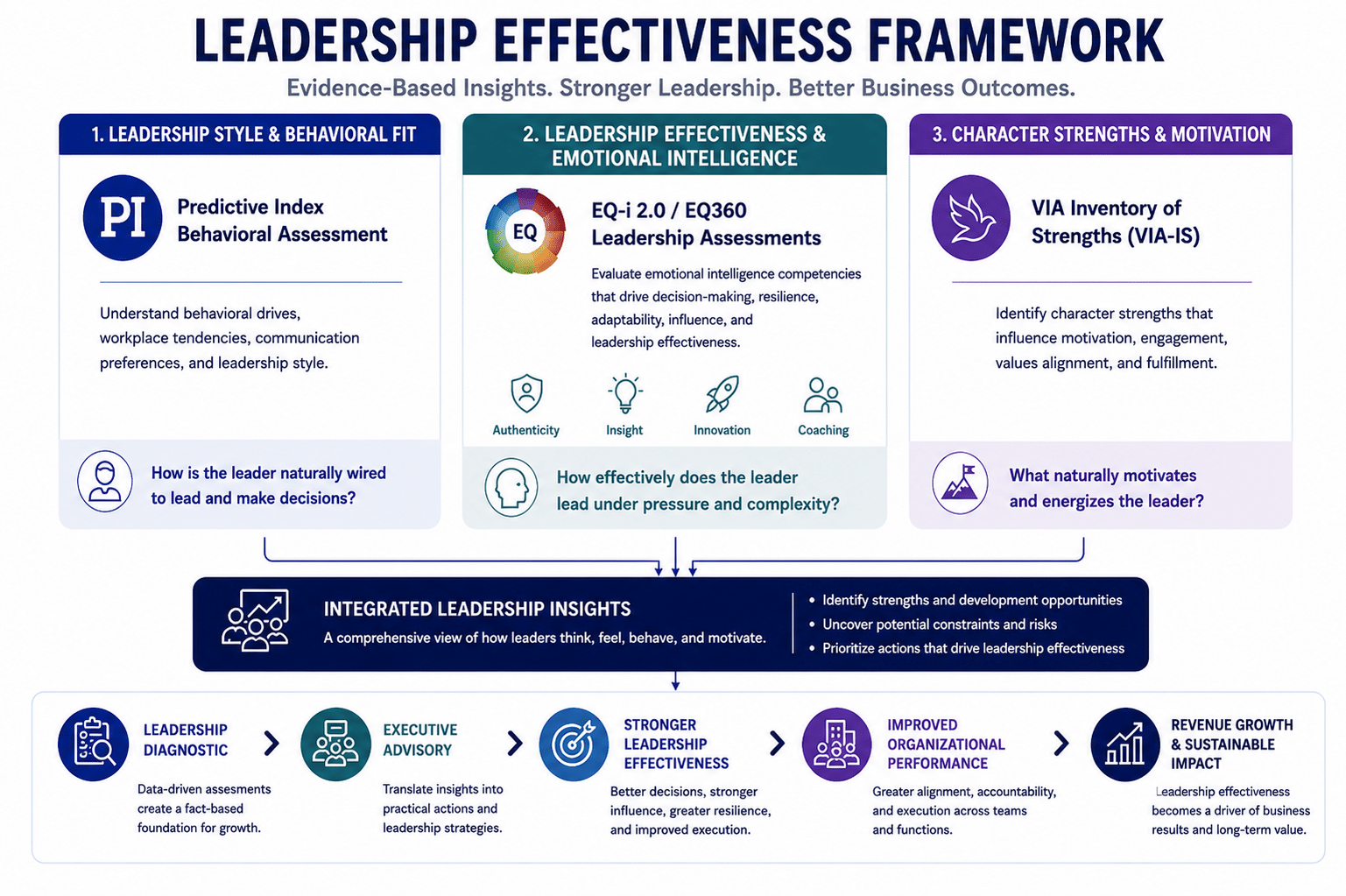
Leadership Style & Behavioral Fit
How is the leader naturally wired to approach work, people, change, and decision-making?
The Predictive Index Behavioral Assessment (PI Behavioral Assessment) provides insight into behavioral drives, workplace tendencies, communication preferences, and leadership style. Understanding these patterns helps leaders identify how they naturally approach challenges, influence others, and operate within complex organizational environments.
Leadership Effectiveness & Emotional Intelligence
How effectively does the leader lead under pressure and complexity?
The EQ-i 2.0 and EQ360 Leadership Assessments evaluate emotional intelligence competencies that influence decision-making, communication, resilience, adaptability, relationship management, and leadership effectiveness. These capabilities become increasingly important as leadership responsibilities expand and organizational complexity grows.
Leaders participating in the EQ-i 2.0 or EQ360 process receive a personalized Leadership EQ Profile highlighting emotional intelligence strengths, leadership capabilities, potential performance risks, and behavioral patterns that influence organizational outcomes.
The EQ-i 2.0 and EQ360 Leadership Reports evaluate transformational leadership dimensions that influence how leaders create impact across organizations:
Authenticity
The ability to lead with clarity, consistency, credibility, and trust during periods of growth, change, and strategic transformation.
Insight
The capacity to clarify priorities, communicate direction, exercise sound judgment, and enable decisive execution.
Innovation
Adaptive thinking and problem-solving capability under changing conditions that improve organizational effectiveness and execution.
Coaching
The ability to develop people, strengthen accountability, provide meaningful feedback, and enable high performance across teams and functions.
Character Strengths & Motivation
What naturally motivates and energizes the leader?
The VIA Inventory of Strengths (VIA-IS) identifies character strengths that influence engagement, fulfillment, values alignment, and intrinsic motivation. Understanding what naturally drives a leader provides valuable insight into how they sustain performance, navigate challenges, and create impact over time.
Together, these dimensions provide a comprehensive view of leadership effectiveness by examining:
- How leaders are wired to lead
- How effectively they lead under pressure
- What naturally motivates and energizes them
This integrated perspective helps leaders and organizations identify strengths, uncover potential constraints, and prioritize development opportunities that support stronger leadership effectiveness, organizational alignment, and execution performance.
Data-Driven Leadership Diagnostics
AlliancesHub uses validated leadership assessment methodologies, including EQ-i 2.0, EQ360, the VIA Inventory of Strengths (VIA-IS), and the Predictive Index Behavioral Assessment (PI Behavioral Assessment), to evaluate how leadership behaviors influence decision-making, communication, collaboration, accountability, and execution effectiveness.
The specific assessment methodology selected depends on the leadership objectives, organizational context, and development priorities being evaluated.
The diagnostic process may provide insight into:
- Leadership strengths and development opportunities
- Emotional intelligence and leadership effectiveness
- Decision-making effectiveness under pressure
- Communication and influence patterns
- Leadership resilience and adaptability
- Character strengths and values alignment
- Behavioral drives and workplace tendencies
- Accountability and execution behaviors
- Stakeholder and relationship management effectiveness
- Potential barriers to leadership effectiveness and organizational performance
These insights create a fact-based foundation for leadership development and executive advisory.
Executive Performance Advisory
Following the diagnostic, leaders may engage in Executive Performance Advisory to translate assessment insights into practical actions that strengthen leadership effectiveness, decision-making, influence, resilience, and execution performance.
The advisory engagement focuses on helping leaders improve how they communicate, align stakeholders, navigate complexity, manage change, and execute against strategic priorities.
Areas of focus may include:
- Executive decision-making and judgment
- Leadership communication and influence
- Executive presence and stakeholder management
- Accountability and execution discipline
- Leadership resilience during growth and change
- Cross-functional alignment and collaboration
- Organizational leadership effectiveness
Engagements are time-bound, outcome-oriented, and aligned to individual leadership goals, organizational priorities, and business performance objectives.
Typical Engagement Structure
Path 1: Executive Leadership Effectiveness Diagnostic
- Leadership Effectiveness Assessment
- Diagnostic Review and Analysis
- Executive Debrief
- Leadership Development Roadmap
Followed by:
- Executive Performance Advisory
- Bi-weekly Executive Advisory Meetings
- Leadership Effectiveness Development Plan
- Accountability and Progress Reviews
- Application to Live Business Challenges
Path 2: Emotionally Effective Leader Workshop
- EQ-i 2.0 or EQ360 Leadership Assessment
- Individual Leadership EQ Profile
- One-Day Emotionally Effective Leader Workshop
- Personal Leadership Development Action Plan
Followed by:
- Executive Performance Advisory (Optional)
- VIA Inventory of Strengths (VIA-IS)
- Predictive Index Behavioral Assessment (PI Behavioral Assessment)
- Expanded Leadership Effectiveness Diagnostic Review
- Ongoing Executive Advisory Support
Emotionally Effective Leader Workshop
Organizations may choose to apply EQ-i 2.0 and EQ360 Leadership Assessment insights through the Emotionally Effective Leader Workshop.
Prior to the workshop, participants complete the EQ-i 2.0 or EQ360 Leadership Assessment. Individual Leadership EQ Profiles are generated and provided during the workshop, creating a foundation for self-awareness, reflection, and leadership development.
This facilitated one-day workshop helps leaders understand their Leadership EQ Profile, interpret key emotional intelligence competencies, and explore how emotional intelligence influences leadership effectiveness, communication, decision-making, resilience, influence, and execution.
The workshop is built around the transformational leadership dimensions evaluated within the EQ-i Leadership Report:
- Authenticity
- Insight
- Innovation
- Coaching
Participants receive their individual Leadership EQ Profiles and learn how emotional intelligence influences leadership effectiveness, organizational alignment, and performance outcomes. The workshop provides practical strategies to leverage strengths, address potential leadership derailers, and improve effectiveness when leading teams, navigating change, and operating under pressure.
As part of a broader Leadership Effectiveness Advisory engagement, additional diagnostic methodologies such as the VIA Inventory of Strengths (VIA-IS) and the Predictive Index Behavioral Assessment (PI Behavioral Assessment) may be incorporated to provide a more comprehensive understanding of leadership style, emotional intelligence, character strengths, motivation, and behavioral tendencies.
This integrated approach helps leaders understand:
- How they are wired to lead
- How effectively they lead under pressure
- What naturally motivates and energizes them
Organizations seeking sustained leadership development and organizational impact may continue into Executive Performance Advisory following the workshop.
Research & Evidence
Leadership effectiveness is a measurable driver of organizational performance.
Research across multiple organizations has demonstrated strong relationships between leadership effectiveness, emotional intelligence competencies, decision quality, productivity, sales performance, employee retention, and organizational outcomes.
Explore leadership effectiveness research, assessment validation studies, and case studies demonstrating how organizations have used evidence-based diagnostics to improve leadership performance, organizational alignment, talent outcomes, and business results.

Business Outcomes
Organizations and leaders use this service to:
- Improve leadership effectiveness and decision quality
- Increase executive and organizational alignment
- Strengthen communication and influence
- Improve execution velocity and accountability
- Reduce friction across functions and teams
- Strengthen resilience during growth and change
- Improve organizational performance and revenue outcomes
Turn leadership effectiveness into a competitive advantage.
